
To measure curtains, take the width of the track or rod (not the window glass), then measure the drop from the top of the track, or the top of the pole for eyelets, down to where you want the hem to finish. Multiply that width by the fullness ratio of your heading, and pick a finished length from the table below: sill, below sill, floor or puddle.
Each step is explained in turn, followed by a worked example in centimetres and the measuring details that catch people out in a Dubai home.
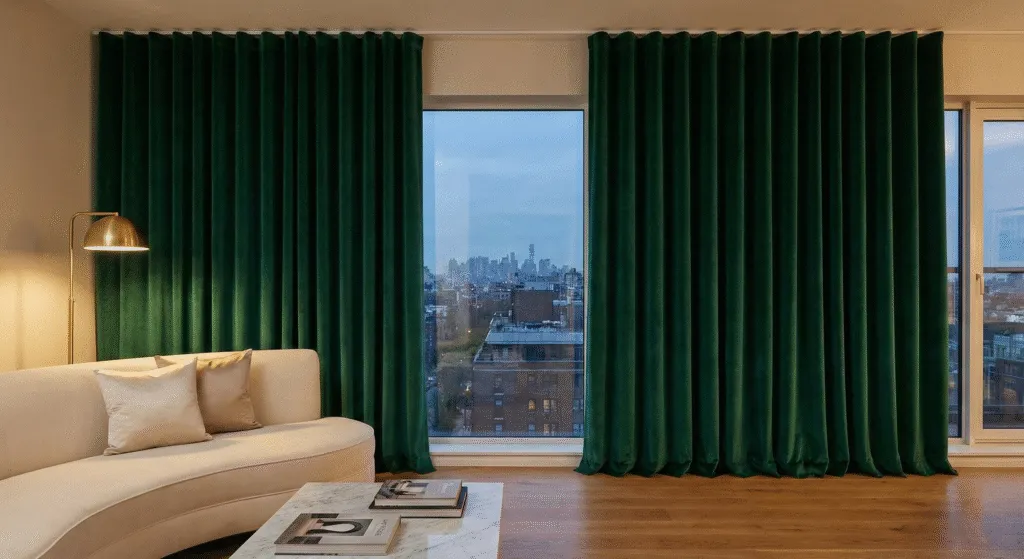
Before You Start
To measure for curtains you need a steel tape measure, a pencil, a notepad and, for tall windows, a stepladder and a helper. A fabric tape can stretch over a long drop, so a steel tape gives a truer reading. Note every measurement in centimetres.
- Fix the hardware first if you can. Measurements taken from an installed track or rod are the most reliable.
- Measure in more than one place. Take the width at the top, middle and bottom and the drop at the left, centre and right, then use the smallest drop, because floors and ceilings are rarely level.
- Check the window is square. Compare both diagonals. If they differ, size the curtains to the hardware.
- Note obstacles. Write down sockets, switches, AC vents and furniture near the window.
Step 1: Position the Rod or Track
Height above the window
The usual position is 10 to 15 cm above the window frame. Hanging it higher, halfway to the ceiling or right up to it, makes the room feel taller and hides the light gap over the top, which is often the best look with low ceilings.
Ceiling fixing
Ceiling fixing means screwing the track upward into the slab instead of the wall. It suits floor to ceiling glass, windows whose head sits just below the ceiling, and bedrooms that need real darkness. Where a gypsum ceiling is in the way, the track needs solid fixings, or it can sit in a ceiling recess or behind a pelmet.
Width beyond the window
Let the rod extend about 15 to 20 cm past the frame on either side. That extra space is where the curtains stack back when open, so the fabric rests against the wall instead of covering the glass.
Step 2: Measure the Curtain Width
With a track or pole in place
Measure the full length of the track, or the curtain rod between the brackets. Leave out the finials, the decorative ends of a pole, because the curtains never slide over them. On tracks with overlapping arms in the centre, measure end to end, then measure the overlap and add the two together.
Without hardware yet
Measure the window frame from outside edge to outside edge and add 15 to 20 cm on each side. Only measure inside the recess if the curtains will hang within it.
Overlap and returns
Where two curtain panels meet in the middle, they overlap by a few centimetres so no daylight shows down the centre. Returns are the short sides that wrap from the face of the curtain back to the wall around the end brackets, usually 5 to 10 cm each. Add the overlap and both returns to the track length to get the total finished curtain width.
Stack back
Stack back is the space the curtains take up when fully open: roughly a quarter to a third of the track width for pleated styles, less for wave curtains and more for thick lined drapes. Check that space will not cover a socket or a light switch.
Step 3: Work Out Fullness by Heading
Curtains are made wider than the track so they fall in folds, and that multiplier is the fullness ratio. It depends on the heading, also called the header, which is the top of the curtain that attaches to the hardware.
| Heading | Fullness ratio | Hangs from | Measure the drop from |
|---|---|---|---|
| Eyelet | 1.5 to 2 times the width | Pole through rings punched into the fabric | Top of the pole |
| Pencil pleat | 2 to 2.5 times | Track, or pole with rings | Top of the track, or bottom of the ring |
| Pinch pleat | 2 to 2.5 times | Track, or pole with rings | Top of the track, or bottom of the ring |
| Wave | 2 to 2.3 times | Wave track with evenly spaced gliders | Top of the track |
Lighter fabrics need a higher fullness ratio. Sheer curtains and voile panels look thin at 2 times and better at 2.5 to 3 times, while thick velvet or blackout looks full at the lower end of the range.
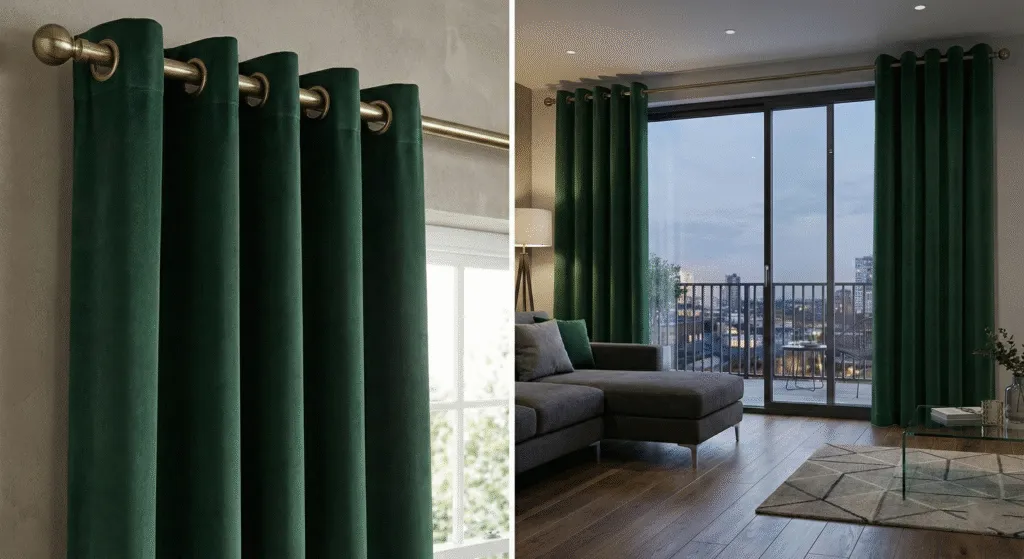
Eyelet
Eyelet Curtains slide straight onto a pole through metal rings. The fabric rises slightly above the pole, so measure the drop from the top of the pole. Eyelets suit a relaxed, modern style.
Pinch pleat
A pinch pleat heading gathers the fabric into stitched groups for a tailored, formal style. On a pole with rings, measure from the bottom of the ring, where the hook sits, not the top of the pole.
Wave
Wave curtains hang from gliders under a slim track, and a wave tape keeps the folds the same size from end to end. Measure from the top of the track. Wave tracks can be curved or bent to follow a bay window, so each section of the bay window is measured separately.
Step 4: Measure the Curtain Drop
The drop is the distance from your starting point (top of the track, top of the pole or bottom of the ring) to where you want the hem. Measure at the left, centre and right and take the smallest. On a marble floor that slopes slightly, this is what stops one end of a floor length hem from dragging.
Curtain Length Guide in cm
This table shows the standard curtain lengths and the adjustment for each. Measure to the reference point, then apply the figure in the third column.
| Curtain length | Where the hem sits | Adjustment | Best for |
|---|---|---|---|
| Sill | Just above the window sill | Measure to the sill, take off 1 cm | Kitchens, small windows, windows above a desk |
| Below sill | Past the bottom of the sill | Measure to the sill, add 10 to 15 cm | Bedrooms and nurseries with furniture underneath |
| Floor length | Just clear of the floor | Measure to the floor, take off 1 cm | Living rooms, bedrooms, sliding doors |
| Kissing the floor | Just touching the floor | Measure to the floor, add 1 to 2 cm | Formal rooms wanting a softer finish |
| Puddle | Pooling on the floor | Measure to the floor, add 5 to 15 cm | Luxurious formal rooms with little foot traffic |
Floor length is the most popular of the standard lengths and makes a room look taller. A puddle looks dramatic but needs rearranging each time the curtains are drawn.
Worked Example: A Bedroom Window
Here is how to measure curtains for a typical apartment bedroom with a pinch pleat blackout curtain on a wall fixed track.
- Window. The frame is 180 cm wide, and its top sits 215 cm from the floor.
- Track. It goes 15 cm above the frame, at 230 cm, and runs 20 cm past each side, so it is 220 cm long.
- Width. Add a 10 cm centre overlap and 8 cm returns each side: 220 + 10 + 16 = 246 cm total finished width.
- Fullness. At 2 times for pinch pleat, the flat fabric is 246 × 2 = 492 cm, made as two panels of 246 cm.
- Drop. Top of track to floor reads 230 cm, 229.5 cm and 230.5 cm. Take 229.5 cm and subtract 1 cm: the finished drop is 228.5 cm.
Those measurements, plus the heading and fabric, are all a workroom needs to make custom curtains.
Measuring Curtains in Dubai Homes
Floor to ceiling glass in apartments
Many Dubai apartments have glass from slab to slab with no wall above it. A ceiling fixed track running wall to wall is the neatest answer. Slabs are rarely level across a wide opening, so take a drop reading every metre, not just three.

Tall villa windows
Double height windows in a villa can need drops of four or five metres, where fabric weight, joins and rod strength all matter. Motorized Curtains remove the reach problem. When you measure for curtains on a motorized track, allow for the motor at one end and check there is a power socket nearby.

Blackout gaps that let in the sun
Morning sun is strong here, so a thin light gap around blackout curtains wakes people early and puts glare on a TV. Light leaks over the top, down the sides, through the centre and under the hem. Close those gaps with ceiling fixing or Pelmet Curtains, returns, a centre overlap and a hem within 1 cm of the floor. For linings and fabrics that keep heat out, see our guide to sun blocking curtains.
Sand and dust on puddled hems
Sand and dust blow in through balcony doors, and a puddled hem sweeps them up. A hem 1 cm clear stays cleaner and means less washing of heavy drapes.
AC vents and sockets
Split units often sit just above a window. Curtains hanging over a vent block the air conditioning and billow, so check the rod height and stack back against every grille, socket and switch.
Sheers and blackout together
Most bedrooms here use a double track with sheer curtains in front for daytime privacy and blackout behind. Each layer has its own drop and width, so measure both. If fabric suits a window poorly, our curtains vs blinds comparison may help.
Free Measurement With Intex Aura
Measuring at home yourself is useful for planning, but a made to measure curtain should be cut from figures taken by the people who will fit it. Intex Aura measures for free on a site visit anywhere in the UAE. Our team checks ceiling heights, fixing points, sockets and AC vents, brings fabric swatches to compare against your walls, and gives you a free quote. The same team handles everything from the survey to the fitting, and we can visit on a weekend or in the evening.
Browse our full curtains collection, then Book a free site visit and let us take the measurements for you.
Measuring Curtains FAQs
How do I measure for curtains?
Measure the track or pole width without the finials, then the drop to where you want the hem. Multiply the width by the fullness your heading needs.
How wide should curtains be?
The track should extend 15 to 20 cm past each side of the frame, and the fabric should be 1.5 to 2.5 times the track width, or up to 3 times for sheers.
How far above the window should a curtain rod go?
About 10 to 15 cm above the window frame. To make the room feel taller or stop light leaking over the top, fix it higher or on the ceiling.
How long should curtains be?
Floor length curtains should finish about 1 cm above the floor so they hang straight. Sill curtains finish 1 cm above the sill, and below sill curtains 10 to 15 cm under it.
How much do you add for puddled curtains?
Add 5 to 15 cm to the floor measurement. In dusty homes a puddle collects sand, so a hem just clear of the floor is easier to keep clean.
Where do you measure the drop for eyelet curtains?
From the top of the pole, because the fabric sits slightly above it. For pleated curtains on a pole, measure from the bottom of the ring.
Does Intex Aura measure curtains for free?
Yes. Intex Aura measures windows for free on a site visit anywhere in the UAE and gives a free quote, so you never order from your own measurements.
Not sure how to measure your windows?
Tell us which rooms need curtains, and we will measure every window, bring fabric swatches and give you a free quote on a free site visit.